
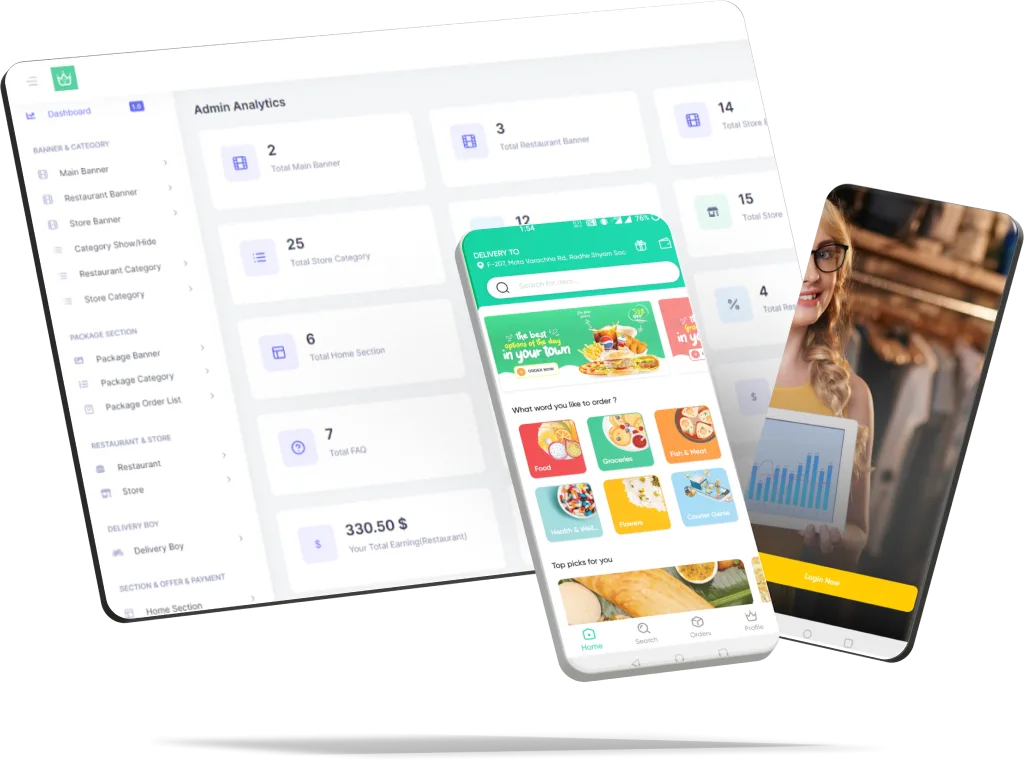
Food delivery app development cost can vary widely because the product is not a single app. It is usually a system of apps and dashboards that work together to manage customers, restaurants, couriers, payments, and support.
That is why asking for one flat number rarely helps. A small local launch, a multi-restaurant marketplace, and a large on-demand delivery platform all require different architecture, different support flows, and different levels of testing.
Food Delivery App Cost: 2026 Market Rates
In 2026, typical food delivery app costs range from $8-20k for white-label (2-3 week launch), $45-80k for custom MVP (8-12 weeks), $120-200k for full-featured custom (16-20 weeks), and $300k+ for enterprise scale (6+ months). Market rates vary by geography: US/European developers charge 2-3x more than Indian or Eastern European developers. However, cheaper doesn't always mean better—development quality, post-launch support, and code maintainability matter more than hourly rate.
Key insight: the most expensive component is not the initial build—it's operational complexity post-launch. A poorly architected app might cost $40k to build but $20k/month to operate. A well-architected app might cost $80k to build but $3k/month to operate. Think total cost of ownership, not just development spend.
What Drives the Price Most?
The biggest cost drivers are usually the number of user roles, the quality of the design, the number of third-party integrations, and whether the platform needs live tracking or complex dispatch logic. Every extra layer adds development and QA work:
- User roles (+cost per role): Customer app only = baseline. Add restaurant dashboard = +$10-15k. Add delivery driver app = +$10-15k. Add admin panel = +$8-12k. Full platform (all 4) = 2.5-3x baseline cost.
- Ordering flows (+$2-5k per variant): Basic ordering (search → add to cart → checkout) = included. Add scheduled orders = +$3-5k. Add subscription billing = +$5-8k. Add bulk/corporate orders = +$8-12k.
- Real-time features (expensive): Basic order status = $2-3k. Live tracking (GPS) = +$5-8k. Live chat with support = +$5-10k. Real-time notifications (push + SMS) = +$3-5k. All together = adds $15-25k.
- Payment complexity: Single payment method (card) = $2-3k. Multiple methods (card, wallet, cash, subscriptions) = +$8-12k. Payouts to restaurants = +$5-8k (escrow, accounting).
- Integrations: Each third-party API = $1-3k to integrate. Maps = $3-5k. SMS gateway = $2-3k. Email service = $1-2k. Analytics = $2-3k. Support = $2-3k.
- Design quality: Basic design (bootstrap templates) = included. Custom design (wireframes + mockups + polish) = +$10-20k. Premium animations and micro-interactions = +$8-15k.
Cost Comparison: Marketplace vs Single-Brand vs White-Label
| Model | Developer Cost | Timeline | Customization | Scalability | Tech Debt |
|---|---|---|---|---|---|
| White-Label | $8-20k | 2-3 weeks | Logo + colors | 50k users max | Very high |
| White-Label + Customization | $20-40k | 4-6 weeks | Workflows, integrations | 100k users max | High |
| Custom MVP (Marketplace) | $45-80k | 8-12 weeks | Full customization | 500k+ users | Low |
| Custom Single-Brand | $35-60k | 8-12 weeks | Full customization | 500k+ users | Low |
| Full Custom (Enterprise) | $150-250k | 16-24 weeks | Complete control | Unlimited | Lowest |
Typical Build Layers & Cost Breakdown
| Layer | What It Includes | Development Cost | Timeline | When to Build |
|---|---|---|---|---|
| MVP | Customer app (search, cart, checkout), restaurant panel (orders, menu), delivery assignment, basic admin | $40-70k | 8-12 weeks | Validate market fit, prove demand |
| MVP + Growth Features | Promotions/coupons, restaurant analytics, customer ratings, basic loyalty, SMS notifications | $70-110k | 12-16 weeks | After MVP shows traction (500+ weekly orders) |
| Advanced Platform | Scheduled orders, subscriptions, multi-restaurant management, geo-targeting, advanced loyalty, marketing automation | $150-200k | 18-24 weeks | After growth features prove viable (2000+ weekly orders) |
| Enterprise Scale | Multi-city operations, AI-powered dispatch, predictive analytics, franchise management, API for external integrations | $300k+ | 6+ months | After scaling to multiple cities profitably |
Detailed Component Cost Breakdown
| Component | % of Budget | Cost (MVP) | What's Included |
|---|---|---|---|
| Backend/API | 30-35% | $14-25k | Server, database, order logic, payment processing, notifications |
| Customer App (iOS+Android) | 25-30% | $12-22k | Search, menu browsing, cart, checkout, order tracking, ratings |
| Restaurant Dashboard | 15-20% | $7-15k | Order management, menu editor, analytics, promotions |
| Delivery Driver App | 12-18% | $6-14k | Order assignments, navigation, earnings tracking, delivery status |
| Admin Dashboard | 10-15% | $5-11k | Analytics, user management, commission tracking, support tools |
| QA & Testing | 8-12% | $4-9k | Unit tests, integration tests, performance testing, bug fixes |
| Design & UX | 8-12% | $4-9k | Wireframes, mockups, design system, UI polish |
| DevOps & Infrastructure Setup | 5-8% | $2-6k | Hosting, CI/CD pipelines, monitoring, backup systems |
| Documentation & Handoff | 3-5% | $1-4k | Code documentation, API docs, deployment guides |
Real Case Studies: Actual Food Delivery Costs
HungerHub (India) — White-Label Start → Custom Migration
HungerHub launched in Bangalore with white-label ($12k, 2-week launch). Month 1: 20 restaurants, 200 orders. Month 3: 300 orders/week. Realizing white-label limitations, they invested in custom development ($65k, 12 weeks) to own their dispatch logic. Total year-1 investment: $77k. Strategy worked: custom version achieved 2,000 orders/week by month 8. Lesson: white-label lets you validate fast; custom build lets you scale sustainably. The migration cost more but saved development time early.
FoodFast (USA) — Full Custom Build
FoodFast raised $200k seed and built a full custom platform ($140k for development + $30k for design/brand + $15k for initial marketing). They focused on a competitive advantage: predictive delivery time estimation using ML. This required custom backend architecture. Timeline: 18 weeks to launch. Result: 4.8/5 star rating (vs market average 4.2) due to accurate ETA. By month 6, they achieved 1,000 weekly orders with 35% repeat rate (market average 25%). The premium positioning ($2-3 delivery fee vs market $1-1.5) justified the custom build investment. By year 2, they achieved $1.5M annual revenue.
DeliverNow (Southeast Asia) — Rapid Scaling with Custom MVP
DeliverNow built a custom MVP ($55k, 10 weeks) and scaled aggressively. Year 1: launched in 2 cities, 300 restaurants, $500k revenue. Year 2: 8 cities, 1,500 restaurants, $3.5M revenue. Total development spend: $55k initial + $80k for growth features + $40k for advanced platform = $175k over 2 years. This was efficient because they built incrementally, adding features only when they proved necessary. Lesson: custom MVP allows you to iterate based on real user data instead of guessing upfront.
Cost Reduction Strategies (Without Cutting Quality)
- Start with a single city, one restaurant category: Reduces scope by 50-60%. After proving model works, expand. Example: launch with quick-service restaurants only (burgers, pizza), then add fine dining later.
- Use third-party services for non-core functions: Don't build customer support software—use Zendesk ($25/month). Don't build SMS—use Twilio. This saves $5-10k per function.
- Choose developers wisely: Geographic arbitrage matters. Indian developers: $15-25/hour. US developers: $75-150/hour. Same quality is possible at different price points. However, avoid the cheapest option—mid-tier is usually best.
- Prioritize ruthlessly: Build only features that directly impact user retention or revenue in month 1. Defer nice-to-haves (advanced analytics, AI recommendations) to month 6+.
- Use white-label as a stepping stone: Launch white-label to validate market ($12-15k). After proving demand, invest in custom ($60-80k more). Total $72-95k but you didn't waste custom development on an unproven market.
Post-Launch Costs (Often Underestimated)
Remember that development cost is only part of the total cost of ownership:
- Hosting & infrastructure: $500-1,500/month (servers, database, CDN, backups)
- Third-party APIs (per transaction): $200-500/month (maps, SMS, analytics, payment processing). Scales with volume.
- Support team: $2-5k/month (customer support, dispute resolution, driver management)
- Maintenance & bug fixes: $1-3k/month (ongoing support, security patches, optimization)
- Version updates: After 6-12 months, you'll want V2 redesign or feature overhaul = $30-60k
How to Reduce Cost Without Reducing Quality
The smartest way to control cost is to reduce scope, not quality. Focus on one city, one restaurant category, and one clean ordering flow. That lets you launch faster and keep budget available for marketing and support.
It also helps to choose a framework and backend stack that your team can maintain later. A stable codebase is cheaper over time than a rushed build that constantly needs patching.
FAQ: Food Delivery App Cost Questions
Should I build custom or use white-label?
White-label if you want to validate market in 2-3 weeks for $12-15k. Custom if you've already proven demand or want differentiation. If unsure, start white-label, validate, then migrate to custom if metrics are strong.
What's the total cost to launch AND run a food delivery app for 12 months?
Custom MVP approach: $50-80k (development) + $8-15k (hosting/APIs) + $20-40k (marketing/CAC) + $10-20k (operations staff) = $88-155k year 1. Most startups fall into the $100-130k range.
Can I launch with less than $50k?
Yes, using white-label + heavy customization: $20-40k (white-label + custom workflow changes). But you'll hit scalability limits at 50-100k users and will need to migrate to custom eventually. Better to spend $60-80k on custom MVP upfront if possible.
Which is more expensive: marketplace or single-brand delivery app?
Marketplace is slightly more complex (restaurant management, rating system, multi-restaurant dispatch) = $50-80k. Single-brand is simpler (one menu, simpler fulfillment) = $40-65k. Difference is modest (10-20%), but marketplace scales better because you don't need to manage inventory or kitchen operations.
The right food delivery app cost is not the cheapest quote. It is the cost that gets you a stable launch, enough flexibility to grow, and a codebase your team can maintain long-term. Start with a clear scope, focus on MVP validation, and plan for post-launch iteration based on real user feedback.


