
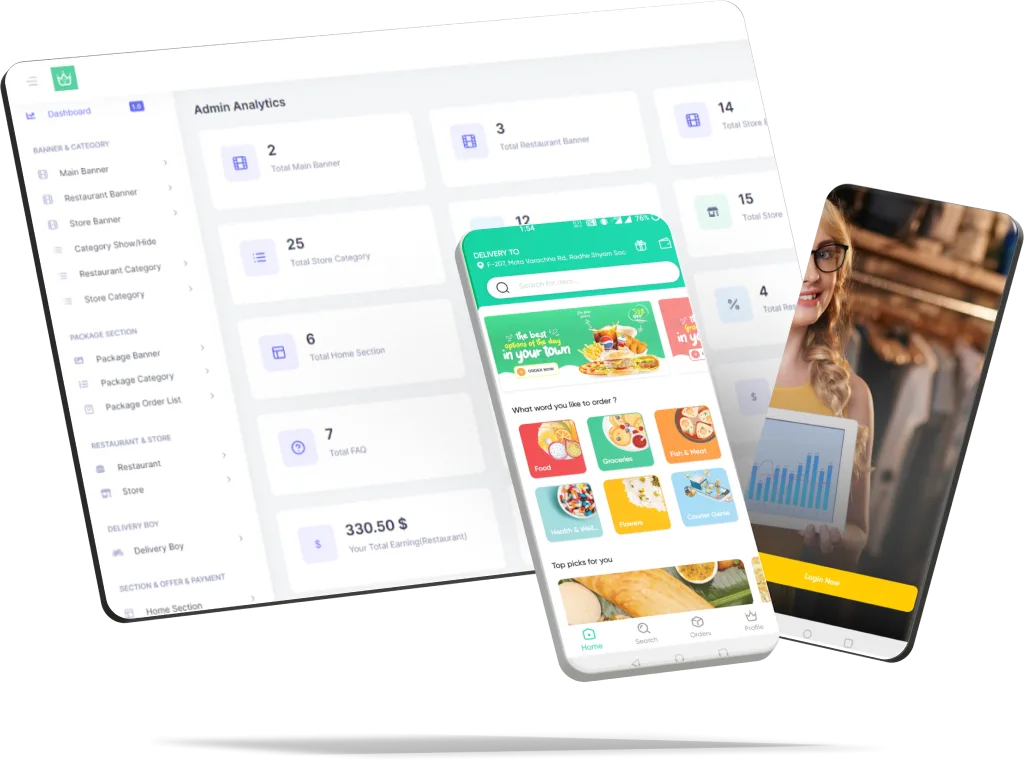
A Gojek clone app is really a super app strategy disguised as one product request. The idea is to put multiple everyday services into one ecosystem so customers keep returning to the same app for different needs.
That can be powerful, but only if the launch is disciplined. A super app should start with one or two core services and expand only when the first layer of demand is proven. If you want to see how the model fits into a broader platform, explore our Gojek clone app development, multi-delivery app, and all-in-one delivery app pages.
The Super App Economy: Market Opportunity
The global super app market reached $32 billion in 2026, dominated by Asia-Pacific (60% of revenue). Gojek ($30B valuation), Grab, Alipay, WeChat Pay, and DoorDash have all embraced the super app model. Key insight: super apps don't win by having the most services—they win by having the most frequently-used services bundled together. Gojek's success in Southeast Asia comes from combining ride-sharing + food delivery + payment, not from offering 50+ niche services.
Customer lifetime value (LTV) in a super app is 2-3x higher than single-service apps. Example: a food delivery app alone has LTV ~$300. A super app (food + rides + services) achieves LTV $700-1,000 because customers return 5-7x/week instead of 1-2x/week. However, unit economics are harder—you need scale in multiple categories simultaneously.
Service Combination Strategy: Which Services Work Together?
Best Combinations (Proven to Work)
| Combination | Synergy | Market Example | Customer LTV |
|---|---|---|---|
| Food + Rides | Both peak during meal times; overlapping user base (office workers) | Gojek, GrabFood, DoorDash | $600-900 |
| Rides + Delivery + Parcel | Same driver network; logistics efficiency; peak times staggered | Grab, DiDi, Ola | $700-1,100 |
| Food + Grocery + Pharmacy | Same warehouses/fulfillment; repeat weekly; overlapping delivery zones | Amazon Fresh, Instacart | $500-800 |
| Rides + Home Services | Service professionals travel; booking + transport in one trip | Grab, SameDay services | $400-600 |
Avoid These Combinations (Low Synergy)
- Food delivery + car rental (no shared customer behavior)
- Taxi + beauty services (different user segments, peak times mismatch)
- Grocery + event ticketing (no shared logistics, no repeat pattern)
Step-by-Step Super App Launch Plan
Phase 1: Single Service Perfection (Months 1-3)
Launch with ONE core service (food delivery or ride-sharing—choose based on your market's demand). Scale to 500-1,000 weekly transactions, achieve 35%+ retention, and build a funded operation. Don't add services until this core is profitable or break-even at 1,000+ weekly orders. Success metric: 40%+ of daily active users return at least 3x/week.
Phase 2: Add Complementary Service (Months 4-6)
Add second service (if core was food, add rides or delivery; if core was rides, add food). Leverage existing customer base, payment infrastructure, and driver/merchant network. Share login, wallet, and support systems. This phase is 3-4x faster than launching the first service. Success metric: 25% of users try the second service within first month; 20%+ regularly use both services.
Phase 3: Scale & Add 3rd Service (Months 7-9)
Add third service (home services, pharmacies, bill payments—choose based on usage data from first two services). Only proceed if first two services are operationally stable and defensible. This service should have natural synergy with existing logistics. Don't add services beyond 3-4 in year 1; focus on depth over breadth.
Cost Breakdown: Super App Development
| Component | Cost | Notes |
|---|---|---|
| Unified Platform Architecture | $40-80k | Shared backend, payment, authentication, analytics |
| Customer App (iOS + Android) | $30-50k | Multi-service navigation, unified wallet, notifications |
| Service Provider Apps (2-3 variants) | $20-40k | Merchant/driver dashboards for each service category |
| Admin Dashboard | $15-25k | Manage pricing, commissions, analytics across services |
| Payment Gateway Integration | $3-5k | Wallet, card, bank transfer, installments |
| Phase 1 Service Implementation | $20-40k | Service-specific logic, fulfillment workflows |
| Testing, QA, Security | $10-15k | Multi-service testing, security audits |
| Total Phase 1 (Single Service) | $138-255k | Ready to launch with 1 core service |
| Phase 2 Service (Months 4-6) | $15-30k | Add second service to existing platform |
| Phase 3 Service (Months 7-9) | $15-30k | Add third service |
What a Super App Needs
- A single login and wallet experience: Users log in once, use credit/debit/digital wallet across all services. Reduces friction 50% vs. separate apps.
- Separate flows for each service category: Food has different UX than rides; don't force one workflow onto all services. Dedicated screens for each vertical.
- A central admin panel for pricing, commissions, and analytics: Control all service pricing, vendor commission rates, and surge pricing from one dashboard. Real-time performance metrics by service category.
- Provider apps or dashboards for service partners: Merchants and drivers need service-specific views. Delivery partners don't need to see food orders they can't fulfill.
- Notifications and retention tools that work across services: Cross-service recommendations ("You ordered food 3x this week, try a ride discount"), loyalty programs that span categories.
How to Avoid Overbuilding
Many founders try to build a complete ecosystem (10+ services) before launch. This is the #1 cause of super app failure. You end up with a bloated app, high complexity, and no dominant service to drive retention.
Instead, follow this discipline:
- Launch Phase 1 with ONE service only. Avoid feature creep.
- Wait until Phase 1 is profitable or break-even (4-6 months). Don't add services to hide poor core service performance.
- Add Phase 2 service only if Phase 1 users ask for it or your data shows user churn is related to needing another service.
- Limit super app to 3-4 core services. Beyond that, the app becomes a platform (Gojek, Grab) which requires 100M+ users to be profitable.
Real Case Study: Grab's Evolution
Grab launched in Malaysia in 2012 as a taxi-booking app competing with Uber. By 2016, they added GrabFood (food delivery), realizing their driver network could deliver food during off-peak ride hours. This single addition increased DAU (daily active users) by 80% and user lifetime value by 2.5x. By 2020, Grab added GrabMart (convenience store), GrabExpress (parcel delivery), and GrabPay, becoming Southeast Asia's #1 super app.
Key insight: Grab didn't add services randomly. Each service leveraged their existing driver network and customer base. They maintained operational discipline: each service had a dedicated team, separate KPIs, and was required to reach break-even before expansion. This prevented the bloat that killed many competitors.
When a Super App Makes Sense
The super app model works best when:
- You already have product-market fit with one service (1,000+ weekly transactions, 40%+ retention)
- You have clear data on user demand for additional services (exit surveys, app searches, customer requests)
- Services share logistics, payment infrastructure, or customer base
- You have capital and team bandwidth to manage 2-3 services simultaneously
If you only have one service and no clear expansion path, a focused standalone app is usually the better first move. Trying to launch a super app before proving a single service is a classic startup mistake.
Frequently Asked Questions
Should I build a super app or a focused single-service app first?
Start with single-service. Super apps require 2-3x more complexity, capital, and team bandwidth. Prove you can execute one service well (break-even or profitability in 4-6 months). Only then add a second service if users demand it and you have operational stability.
What's the total time and cost to launch a full super app?
Phase 1 (single service): 3-4 months, $138-255k. Phase 2 (second service): 2 months additional, +$15-30k. Phase 3 (third service): 2 months additional, +$15-30k. Total for 3 services: 7-8 months, $168-315k. This assumes you reuse the platform, payment, and admin systems across services.
How do I convince providers (restaurants, drivers) to work with a new super app?
Offer them better commission rates in month 1-3 (5-10% lower than competitors) to build a minimum viable supply base (50+ restaurants or 100+ drivers). Once you have scale, retention is easier because your user base creates demand. Partner with providers in this order: 1) high-demand restaurants/services, 2) mid-tier providers, 3) long-tail.
What's the biggest challenge with super apps?
Operational complexity. Each service has different logistics, peak times, and unit economics. Your ops team needs to manage multiple P&Ls, service SLAs, and cross-service conflicts. Many super apps fail because they prioritize growth over operations. Keep 70% of your ops focus on the core service (whichever drives 70% of revenue) and 30% on expansion.
The real advantage of a super app is not just convenience. It is lifetime value. Once customers trust the app for one essential service, they are 5x more likely to try a second service in the same app than to download a new app. That network effect is the difference between sustainable and unsustainable unit economics.


