
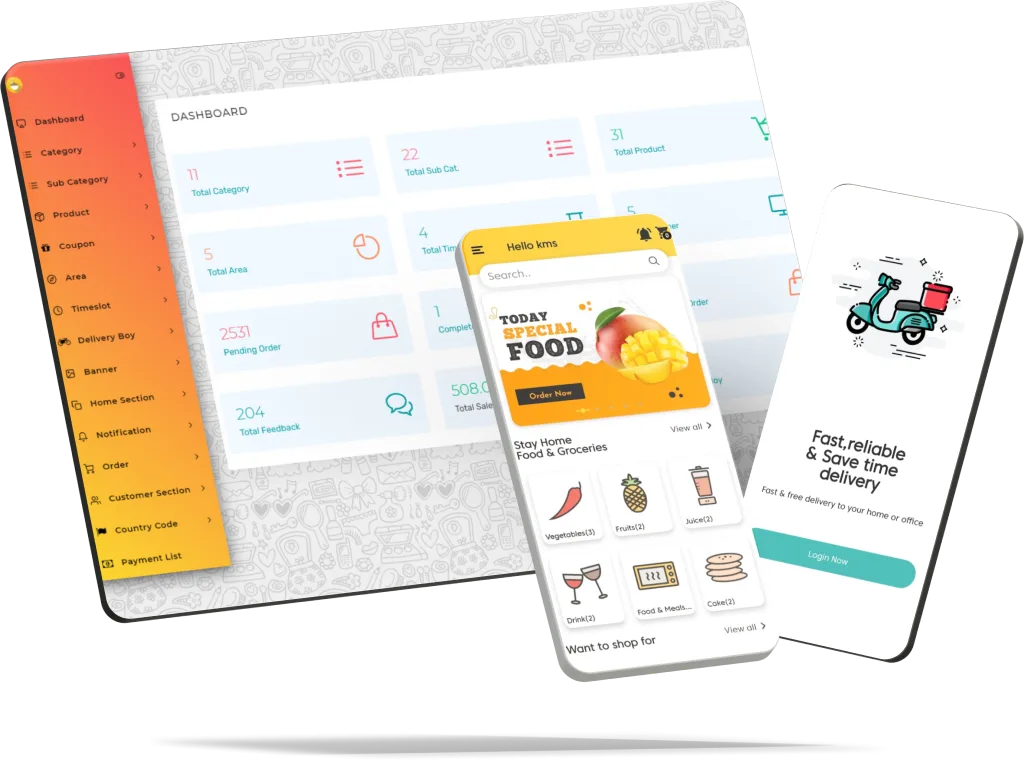
Starting a grocery delivery business in 2026 is less about copying a big marketplace and more about building a dependable service that fits a specific neighborhood, city, or customer segment.
The businesses that work best usually keep the first launch narrow. They choose a service area carefully, set realistic delivery windows, and build a grocery app that is simple enough for repeat orders. If you want to see the product side, start with our grocery delivery app, milk delivery app, and food delivery app pages.
Grocery Delivery Market: 2026 Landscape
Global grocery e-commerce reached $335 billion in 2026, with 18% annual growth. However, profitability varies dramatically by model: quick commerce (10-15 min delivery) has negative unit economics at scale (Amazon Fresh struggling), traditional grocery delivery (next-day) is profitable with 8-15% net margins, and niche grocery (organic, specialty, bulk) achieves 20-30% margins. Key insight: the winners are not trying to offer everything—they're succeeding with specific niches (organic groceries, bulk buying, meal kits, international foods) or specific customer segments (busy professionals, elderly, subscription-based).
Customer acquisition cost is high ($8-15 per customer) but lifetime value is also high ($300-600) because groceries are weekly repeat purchases. Break-even occurs at 200-300 weekly orders, which most startups reach in 3-4 months if CAC is controlled.
Business Models: Which One Works Best?
Marketplace Model (Aggregator)
Connect multiple grocery stores/supermarkets to your app, take 15-25% commission per order. Benefits: no inventory risk, minimal upfront capital. Drawbacks: thin margins (15% commission - 5% delivery costs - 3% payment fees = 7% net), complex operations (inventory from multiple stores), fulfillment dependency (stores pick and pack orders). Unit economics: break-even at 200-250 weekly orders. Best for: cities with fragmented grocery supply, tier-2 cities where consolidation adds value.
Owned Inventory Dark Store Model
You operate 1-3 small warehouses (dark stores, 2,000-5,000 sq ft) stocked with fast-moving items. Fulfill orders from your inventory. Benefits: full margin control (60-70% gross margin), fast delivery (30-60 min), repeatable logistics. Drawbacks: significant capex ($50-150k per dark store), complex inventory management, high labor costs. Unit economics: 60% gross margin - 20% delivery/fulfillment costs - 15% marketing - 10% overhead = 15% net margin at scale. Best for: densely populated urban areas, premium price positioning, high-order frequency. This is Amazon Fresh's model—profitable only at massive scale.
Subscription Grocery Model
Customers subscribe ($99-299/month) for unlimited deliveries of curated groceries (organic, meal prep, healthy). Benefits: predictable recurring revenue, lower marketing costs, loyal customer base. Drawbacks: requires differentiation (quality, curation, sustainability), niche appeal. Unit economics: $150/month subscription * 60% retention = $90 LTV per month, $1,080 annual LTV. Break-even at 100-150 subscribers. Best for: health-conscious customers, premium positioning, sustainability focus.
Step-by-Step Launch Plan (10-14 Weeks)
Week 1-2: Business Setup & Supplier Negotiations
For marketplace: negotiate with 15-25 grocery stores/supermarkets. Offer zero commission on first 50 orders to build supply. For dark store: secure 2,000-4,000 sq ft warehouse space, apply for food handling permits. Identify wholesale suppliers for fast-moving items (dairy, produce, staples). Cost: $3-8k (legal, licenses, deposits). Timeline: 10-14 days.
Week 3-4: Inventory & Fulfillment Setup
For marketplace: integrate with 10-15 stores via API/manual data entry. Ensure real-time inventory sync. For dark store: stock initial inventory (1,500-2,000 SKUs of staples, produce, dairy, frozen), setup inventory management system, hire warehouse staff (picker, packer). Cost: $5-15k (for dark store inventory). Timeline: 10-14 days.
Week 5-6: App Development & Delivery Setup
Deploy customer app (search, smart sorting, easy cart, subscription option), store/warehouse admin panel (inventory, order management), and delivery tracking. Integrate payment gateway. For dark store: hire 5-8 delivery staff, setup route optimization, purchase vehicles/motorcycles. Cost: $8-20k (app development for custom, $5-10k for white-label). Timeline: 10-14 days.
Week 7-8: Testing & Process Refinement
Conduct 100+ test orders. Measure: order accuracy (99%+ target), delivery time accuracy (within 15 min of promised slot), inventory sync (99%+ accuracy), customer satisfaction (4.5+/5). Fix bugs in substitution flow, pickup process, and delivery tracking. Cost: $1-3k (test materials). Timeline: 7-10 days.
Week 9-10: Soft Launch (Beta)
Go live with 200 beta users in 1-2 zip codes. Offer 25-35% discount to encourage orders. Run 300-400 orders. Monitor fulfillment bottlenecks, customer feedback, and repeat rate. Optimize for 30%+ repeat rate (customer orders 2+ times in month 1). Cost: $2-5k (discounts). Timeline: 7-10 days.
Week 11-14: Launch & Scale
Reduce discounts to 10-15%, expand to 3-5 neighborhoods. Hit 500-800 weekly orders. Measure CAC vs. LTV. If CAC/LTV is favorable (<25%), increase marketing spend. If unfavorable, optimize selection or pricing. Cost: $5-10k (marketing, operations). Timeline: 21-28 days.
Cost Breakdown: Grocery Delivery Launch
| Expense | Marketplace | Dark Store | Subscription |
|---|---|---|---|
| Business/Licensing | $2-5k | $3-8k | $2-5k |
| Warehouse/Space | $0 | $15-40k (first 3 mo.) | $3-8k (shared space) |
| Initial Inventory | $0 (stores stock) | $20-50k | $5-15k |
| App Development | $8-20k (custom) or $5-10k (white-label) | $12-25k | $10-20k |
| Delivery/Fulfillment Setup | $3-8k (routing) | $8-15k (vehicles, staff) | $5-10k |
| Payment Gateway | $1-2k | $1-2k | $1-2k |
| Marketing (Month 1) | $5-10k | $5-10k | $3-8k |
| Operations Overhead | $3-6k | $8-15k | $3-6k |
| Total 10-14 weeks | $22-71k | $72-165k | $32-74k |
Choose the Right Business Model
Marketplace model is best if you want to launch fast with minimal capital ($22-35k), are good at negotiating with stores, and want low operational burden. Ideal for tier-2 cities where store supply is fragmented.
Dark store model is best if you want full margin control, can afford $72-165k upfront investment, and are in a densely populated urban area. Requires operational excellence and intense customer acquisition.
Subscription model is best if you want predictable recurring revenue, can differentiate (organic, sustainability, meal prep), and want to build community around a lifestyle. Lower CAC, loyal customer base, but niche appeal.
Features Your App Should Not Skip
| Feature | Why it matters | Implementation |
|---|---|---|
| Smart search & filtering | Customers find items in 30 seconds, not 5 min | Auto-complete, category suggestions, filters (organic, local, price) |
| Easy repeat ordering | Grocery is habitual; repeat customers are 70% of revenue | Save cart, one-click reorder, subscription option |
| Substitution flow | Prevents order cancellations when items unavailable (15-20% without this) | Suggest alternatives before delivery, let customer approve |
| Delivery slot selection | Helps you manage demand and set expectations | Show available slots, let customer pick (today, tomorrow, specific time) |
| Real-time inventory | Reduces customer frustration, improves trust | Sync stock from store every 15-30 min, show "Out of stock" badge |
| Order tracking | Reduces support calls, improves customer confidence | Show when order is being picked, en route, arriving soon |
| Admin inventory panel | Keep product data accurate; wrong prices/out-of-stock = churn | Bulk upload, real-time sync, profit margin tracking by item |
Real Case Study: FreshMart Bangalore
FreshMart launched in Bangalore in 2023 as a marketplace model connecting 30 local supermarkets. They focused on neighborhoods with 50k+ affluent residents. Launch cost: $35k. By month 2, they achieved 300 weekly orders with 28% repeat rate. By month 4, they reached 600 weekly orders and profitability ($8k monthly revenue at 7% net). Key success factors: focused geography (Bangalore suburbs with high density), curated store selection (quality over quantity), and personal customer service (phone support, no chatbots). By 2025, they expanded to 8 Indian cities and achieved $3M+ annual revenue. Lesson: narrow geography and high service quality beat trying to serve everyone with mediocre service.
What Makes Users Stay
Convenience is important, but trust is what keeps customers coming back. Build trust through:
- Accurate inventory: If 30% of your catalog is out-of-stock, customers uninstall. Keep inventory sync <15 min old.
- Reliable delivery windows: Promise 9am-11am, deliver by 11am. If you're frequently 20+ min late, churn spikes.
- Easy returns/complaints: If a customer receives a damaged item, refund them in <5 min. That customer becomes loyal.
- Transparent pricing: No hidden fees, no surprise price changes. Show clearly what they pay.
- Smart substitution: When items are out, suggest good alternatives (not inferior replacements).
Frequently Asked Questions
What's the minimum order value and delivery radius to be profitable?
Minimum order: $25-35 (target). Delivery radius: 3-5 km (15-30 min delivery time). At smaller order values or larger radii, delivery costs spike and you lose margin. Focus on dense areas (urban, densely populated neighborhoods).
How do I compete with Amazon Fresh or local supermarket apps?
You don't. You win by targeting a niche they don't dominate: organic groceries, bulk buying, specialty foods, or hyperlocal (neighborhood-specific pricing/selection). Or choose geography they haven't entered yet (tier-2 cities). Focus on what Amazon can't do: personal service and local relationships.
What's a realistic gross margin for grocery delivery?
Marketplace: 12-18% (15% commission - 3-5% delivery costs). Dark store: 40-50% (60% merchandise margin - 10-20% fulfillment). Subscription: 50-60% (if customers pay upfront). The model you choose determines your margin structure.
How long until I break even?
Marketplace: 3-4 months at 250-300 weekly orders. Dark store: 6-9 months at 400-500 weekly orders (higher upfront costs). Subscription: 4-6 months at 100-150 subscribers. Timeline depends on CAC control and retention.
If you are serious about building a grocery business that can grow, the app should be designed for operations, not just appearances. That is the difference between a good idea and a viable business. Start narrow, execute well, then expand.


