
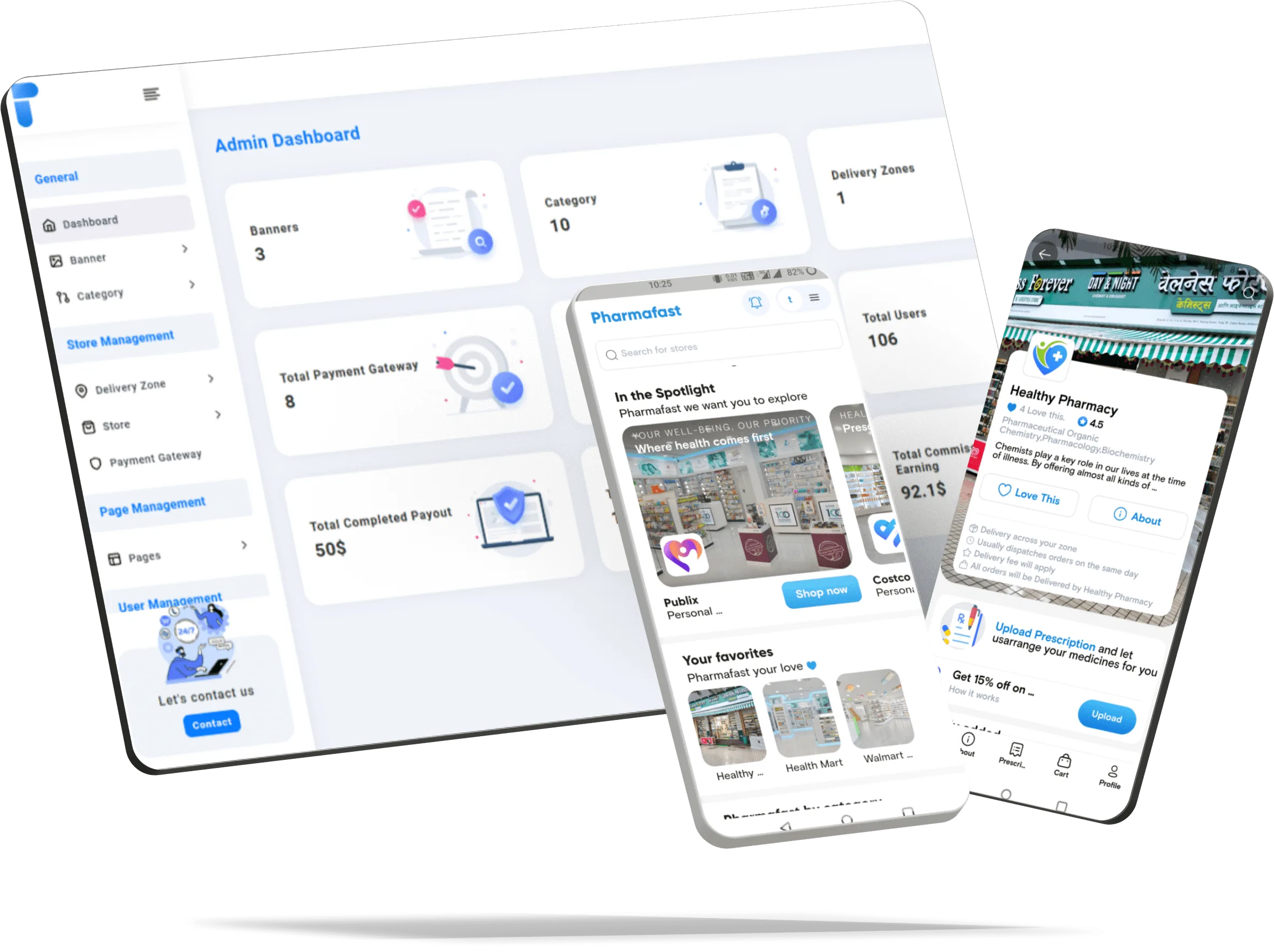
Starting an online pharmacy business in UAE and India is a serious opportunity, but it needs a careful balance of compliance, operational clarity, and customer trust. This is not a category where people forgive confusion.
A pharmacy brand wins when the ordering process feels safe and the app makes prescription handling easy to understand. If you are mapping the product side, begin with our pharmacy app development page and then compare it with our medicine delivery and on-demand service solutions.
Online Pharmacy Market: UAE & India Opportunity
The online pharmacy market in India reached $2.1 billion in 2026 and is growing at 28% annually—the fastest-growing healthcare segment. UAE's online pharmacy market is smaller ($350 million) but growing 22% annually as regulatory barriers ease. Key drivers: rising health awareness, insurance coverage for e-pharma, and convenience-first urban populations. Average order value: India ₹600-1,200 (~$7-14 USD), UAE AED 150-350 (~$40-95 USD). Customer acquisition cost is low (organic search, word-of-mouth average 15-20% of order value) because people actively search for "medicine delivery near me."
Key market difference: India has fragmented pharmacies (500k+ independent stores) creating supply fragmentation; UAE has consolidated pharmacy chains (Boots, Life Pharmacy) creating both barriers and partnership opportunities. Most successful startups partner with existing pharmacies rather than building inventory from scratch.
Regulatory Requirements: UAE vs. India
India: Pharmacy License + DPIIT Approval
Register as a licensed pharmacy with the State Pharmacy Council. Apply for Schedule H online pharmacy licensing (requires holding a valid pharmacy license). Register with DPIIT (Department for Promotion of Industry and Internal Trade) under Startup India if claiming startup benefits. Operational requirements: employ a licensed pharmacist, implement prescription verification system (manual or automated), and maintain medicine cold chain if stocking temperature-sensitive drugs. Compliance cost: ₹1-2 lakhs (~$1,200-2,400 USD). Timeline: 6-8 weeks with legal support.
UAE: Health Authority Approval Required
Obtain a pharmacy establishment license from the Dubai Health Authority (DHA) or Department of Health (Abu Dhabi). Pharmacy must be operated by a licensed pharmacist with at least 2 years UAE experience. E-commerce license from Department of Economic Development. Prescription verification is mandatory—all prescriptions must be reviewed by a licensed pharmacist before dispensing. Compliance cost: AED 30,000-50,000 (~$8k-13.5k USD). Timeline: 8-12 weeks due to background checks and facility inspection.
Step-by-Step Launch Plan
Month 1: Licensing & Pharmacy Partnerships
For India: file pharmacy license application with State Pharmacy Council, hire a licensed pharmacist (₹30,000-50,000/month), and identify 3-5 wholesale pharmacy partners for medicine sourcing. For UAE: submit health authority application, hire a licensed pharmacist with UAE experience, and negotiate partnerships with pharmacy chains. Both regions: secure office/fulfillment space (300-500 sq ft), install cold storage if handling temperature-sensitive medicines.
Month 2: Prescription System & Inventory Setup
Implement prescription upload and verification system (manual review by pharmacist initially, automated after 500+ orders). Source initial inventory: 1,500-2,500 common medicines covering 80% of typical orders (pain relief, cough, antibiotics, diabetes, hypertension). Setup inventory management system with auto-reorder triggers. Implement medicine shelf-life tracking and expiry alerts. Cost: ₹3-5 lakhs (~$3,600-6,000 USD) for initial inventory and management system.
Month 3: App Deployment & Soft Launch
Deploy customer app, pharmacist dashboard, and delivery tracking using white-label pharmacy platform. Configure prescription upload workflow, medicine search, repeat order, and refill reminders. Integrate with payment gateway (India: RazorPay, Phonepe; UAE: Stripe, PayTabs). Conduct 200+ test orders internally and with friends/family. Soft launch to 100 beta users, monitor for prescription verification bottlenecks. Estimated cost: $12,000-20,000 for app deployment and integration.
Cost Breakdown for Launch
| Expense Category | India Cost | UAE Cost | Notes |
|---|---|---|---|
| Pharmacy License & Regulatory | ₹1-2 lakhs | AED 30-50k | License, lawyer fees, background checks |
| Licensed Pharmacist (Month 1-3 salary) | ₹1-1.5 lakhs | AED 15-25k | Mandatory for compliance |
| Initial Inventory (1,500+ medicines) | ₹3-5 lakhs | AED 20-40k | Purchase from wholesale partners |
| Office/Fulfillment Space (3 months) | ₹50-100k | AED 10-20k | 300-500 sq ft with cold storage |
| App Development (White-Label) | $12-20k | $12-20k | Customer, pharmacist, delivery apps |
| Payment Gateway Integration | $1-2k | $1-2k | Fees + security setup |
| Marketing & Launch Campaign | ₹50-100k | AED 10-20k | Google Ads, local social media |
| Initial Operations (team, support) | ₹2-3 lakhs | AED 20-30k | Customer support, delivery coordination |
| Total Startup (3 months) | ₹13-18 lakhs | AED 136-225k | ~$15-22k USD (India) / $37-61k USD (UAE) |
What the Business Model Needs
- Licensed Pharmacy Partners or In-House Inventory: Partner with 3-5 wholesale pharmacies to source medicines at 25-35% discount. This avoids capex and regulatory burden of holding inventory.
- Prescription Upload & Verification Workflow: Pharmacist reviews every prescription (mandatory in UAE, best practice in India). Implement flagging for interactions, contraindications, duplicate prescriptions.
- Inventory & Stock Monitoring: Real-time stock levels synced across inventory system. Auto-reorder when stock hits minimum threshold. Track expiry dates and remove expired medicines weekly.
- Delivery Partner Assignment & Tracking: Route delivery to nearby fulfillment center, assign driver, provide customer tracking. Use GPS to prevent delivery delays and improve accountability.
- Support for Repeat Orders & Refill Reminders: Let customers save prescription, auto-trigger refill reminders when medicine is likely finished (e.g., 25-day supply = refill reminder on day 20). Reduces CAC by 60% for repeat orders.
Features That Build Trust
| Feature | Why it matters | Implementation |
|---|---|---|
| Prescription Upload | Customers need to know their prescription is reviewed by a real pharmacist, not just auto-dispensed | Upload form, manual review queue, pharmacist approval badge |
| Medicine Search & Information | Customers search by generic name or brand; app shows uses, side effects, contraindications | Auto-complete search, medicine detail cards with warnings |
| Refill Reminders | Saves customer effort; increases repeat order rate by 40%; reduces churn | SMS/push reminder when supply is running low based on order history |
| Secure Checkout | Medical info is sensitive; SSL encryption + PCI compliance improves confidence | HTTPS everywhere, PCI DSS Level 1 certification, privacy policy emphasis |
| Order Tracking | Patients have anxiety about medicine delivery; tracking reduces support calls 50% | Real-time GPS tracking, SMS updates at pickup, in-transit, delivery stages |
| Licensed Pharmacist Badge | Show that a real pharmacist reviewed the order, not just a system auto-dispatch | Display pharmacist name and license number on order confirmation |
Real Case Study: Medifresh Launch in India
Medifresh, founded in 2021, started as a medicine delivery platform in Bangalore with a partnership model (no owned inventory). They partnered with 10 local pharmacies for supply. Launch capital: ₹12 lakhs. By month 3, they had 800 registered users and 150 weekly orders. By month 6, they expanded to 2 zones (Bangalore + Hyderabad), grew to 500 weekly orders, and hit ₹2 lakhs monthly revenue.
Success factors: pharmacist-verified prescriptions built customer trust (4.8/5 rating), refill reminders increased repeat orders to 65%, and 2-hour delivery SLA in Tier-1 cities differentiated them. By year 2, they scaled to 5 cities, 5,000+ weekly orders, and ₹50 lakhs monthly revenue. Key learning: partnership model (not owned inventory) was capital-efficient and allowed rapid scaling. Regulatory compliance, not technology, was the real barrier to entry.
Frequently Asked Questions
Do I need to own a pharmacy or can I partner with existing pharmacies?
Partnerships are best for startups. You avoid ₹10-20 lakhs (~$12-24k) inventory capex and pharmacist salary. Instead, partner with 3-5 wholesale or retail pharmacies, offer them 5-10% of order revenue for fulfillment, and focus your capital on app, delivery, and marketing. Most successful e-pharma startups use this model.
What's the timeline from idea to first revenue?
6-8 weeks if you already have pharmacy partnerships and a licensed pharmacist. Register business (2 weeks), secure partnerships (2 weeks), deploy app (3-4 weeks), soft launch and debug (1-2 weeks). Many startups delay because they underestimate regulatory requirements—get a lawyer early.
How do I handle prescription verification at scale?
Start manual: hire a licensed pharmacist to review all prescriptions (200/day is typical capacity). Implement a prescription flagging system to catch duplicate scripts, drug interactions, and over-dosing. Once you hit 1,000+ daily orders, implement automated verification using OCR and drug database APIs (e.g., Goodrx API) to reduce pharmacist workload. Many platforms use hybrid: automation filters, pharmacist reviews exceptions.
What's the customer acquisition cost and how do I keep it low?
Online pharmacy has natural low CAC (₹20-60 / $0.25-0.75 USD per customer) because people actively search for "medicine delivery" and "prescription online." Avoid paid ads initially—focus on organic search (pharmacy near me, medicine delivery) and word-of-mouth (refill reminders drive 40-60% of repeat orders, and referrals drive 10-15%). Paid CAC should not exceed 20% of first-order value.
The winners in online pharmacy are the businesses that prioritize prescription safety, build pharmacist trust into the customer experience, and make reordering effortless. Regulatory compliance is your competitive moat—do it right from day 1.


