
How to Build an App Like Uber in 2026 — Complete Taxi App Development Guide
Uber generated $43.98 billion in revenue in 2023 and continues to grow in markets across Asia, Africa, and Latin America. But Uber is not the only player — inDriver, Bolt, Careem, Ola, and dozens of regional ride-hailing apps collectively serve billions of rides per year. The ride-hailing market is projected to reach $391 billion by 2028, and there is significant room for regional and niche players to capture profitable market share.
This guide explains exactly how to build an app like Uber — covering business model, features, technology stack, development cost, timeline, and the fastest path to launch in 2026.
Understanding the Uber Business Model
Before building a competitor, you need to deeply understand how Uber works as a business. Uber operates on a two-sided marketplace model:
- Demand side: Riders who need transportation
- Supply side: Drivers who own vehicles
- Platform: Uber takes 20–30% commission on every completed trip
Additional revenue streams include Uber One subscription ($9.99/month for priority rides and discounts), Uber Eats (food delivery), Uber Freight (B2B logistics), and advertising on the Uber app. Uber's surge pricing model — where fares automatically increase during peak demand — is one of its most powerful monetization tools, balancing supply and demand in real time.
Choosing Your Ride-Hailing Business Model
Not every ride-hailing app needs to replicate Uber's exact model. In 2026, the most successful new entrants are using differentiated approaches:
Fixed-Fare Model (Uber / Ola Style)
Price is calculated by algorithm at booking. Passengers know the fare upfront. Surge pricing applies during peak demand. Best for: premium, reliability-focused markets (USA, Europe, UAE).
Bidding / Negotiation Model (inDriver Style)
Passengers post a ride with their desired price. Nearby drivers accept, counter-offer, or decline. No platform-set pricing. Best for: price-sensitive markets — Africa, India, Bangladesh, Latin America. inDriver is now the #1 or #2 app in 50+ countries using this model.
Bike Taxi Model (Rapido / Gojek Style)
Two-wheeled motorcycle taxis, often 30–50% cheaper than car taxis. Dominant in India (Rapido: 25 million+ rides/month), Indonesia (Gojek), Vietnam, and Nigeria. Best for: high traffic density, price-sensitive urban markets.
Corporate / B2B Taxi Model
Transportation-as-a-service for corporate employees, hospitals, and hotels. Fixed contracts, monthly billing, priority dispatch. Highest margin, least marketing cost, most recurring revenue.
Must-Have Features for a Taxi Booking App
Passenger App Features
- Real-time driver location on map
- Upfront fare estimation (or bidding system for inDriver model)
- Multiple vehicle type selection (economy, premium, SUV, bike)
- Scheduled rides for future booking
- In-app wallet and multiple payment methods
- Trip history and receipt management
- SOS emergency button with live tracking share
- Driver rating and feedback system
- Ride pooling / carpooling option
Driver App Features
- Online/offline toggle with GPS broadcasting
- Ride accept/decline with passenger details preview
- Turn-by-turn GPS navigation
- Earnings dashboard (daily, weekly, monthly)
- Surge zone map (where to position for higher earnings)
- In-app chat with passenger
- Document upload and verification flow
Admin Panel Features
- Real-time driver and ride monitoring on city map
- Surge pricing controls
- Driver verification management
- Commission and payout management
- Dispute resolution tools
- Analytics: trips per day, revenue, driver utilization, popular routes
- Promo code and referral program management
Technology Stack for a Taxi App in 2026
| Component | Technology | Why |
|---|---|---|
| Mobile Apps (iOS + Android) | Flutter | Single codebase, 60fps UI, fastest time to market |
| Backend API | Node.js + Socket.io | Real-time events: driver location updates, ride matching, chat |
| Database | MySQL + Redis | MySQL for persistent data; Redis for real-time driver location cache |
| Maps & Routing | Google Maps API | Industry standard — best accuracy and routing globally |
| Driver Matching | Custom geospatial algorithm | Nearest-driver logic using lat/lng + real-time availability |
| Payments | Stripe / Razorpay / PayStack | Choose by target market — Stripe (US/EU), Razorpay (India), PayStack (Africa) |
| OTP Verification | MSG91 / Twilio | Reliable SMS delivery globally at low cost |
| Push Notifications | Firebase (FCM) | Free, reliable, cross-platform — iOS and Android |
| Cloud Hosting | AWS / Google Cloud | Auto-scaling handles peak hours and city-wide surge events |
| Admin Dashboard | React / Vue.js | Fast, reactive web panel for real-time fleet monitoring |
Why Flutter for the Mobile Apps?
Flutter has become the dominant choice for ride-hailing apps in 2026 for three reasons: (1) a single codebase compiles to native Android and iOS — cutting development time roughly in half; (2) it produces smooth 60fps animations essential for map interactions; and (3) Google's continued investment in Flutter means strong long-term support. Both inDriver's regional apps and dozens of white-label taxi platforms are built on Flutter.
Why Node.js for the Backend?
Ride-hailing apps have uniquely high real-time requirements — driver GPS coordinates must be pushed to passengers every 2–3 seconds, and ride-matching decisions must happen in under 500ms. Node.js with Socket.io handles thousands of concurrent WebSocket connections efficiently, making it the right fit for this use case. The event-driven architecture also makes it straightforward to add new real-time features like surge zone broadcasting or live driver chat.
Uber Clone App Development Cost in 2026
| Development Approach | Cost Range | Timeline |
|---|---|---|
| White-Label Uber Clone (India-based) | $5,000 – $15,000 | 2–5 days |
| Custom Development (India-based team) | $30,000 – $80,000 | 4–8 months |
| Custom Development (USA/UK team) | $150,000 – $500,000 | 8–18 months |
What Is Included at Each Price Point?
White-label ($5,000–$15,000): Pre-built Flutter passenger app, Flutter driver app, and web admin panel — rebranded with your logo, colors, and app name. Payment gateway configured for your market. Published to your Google Play and App Store accounts within 2–5 business days. Includes GPS tracking, surge pricing, multiple vehicle categories, push notifications, and 12+ payment gateway options. No source code is included at the base price — source code is an add-on.
Custom development ($30,000–$80,000 with Indian team): Purpose-built for your exact business model. Full source code ownership. Can include custom ride-matching algorithm, unique UI, proprietary features (e.g., corporate billing, subscription plans, carpooling). Timeline: 4–8 months depending on scope. Best for founders who have validated demand and want long-term IP ownership.
Custom development ($150,000–$500,000 with US/UK team): Same scope as above but higher hourly rates (US developers: $100–$200/hr vs India: $25–$60/hr). Justified when you need on-site collaboration, specific compliance expertise, or an established local agency relationship. Timeline: 8–18 months.
Taxi App Development Timeline — Week by Week
For a white-label launch, the timeline is measured in days. For custom development, here is a realistic week-by-week breakdown for a mid-complexity taxi app:
| Week | Milestone |
|---|---|
| Week 1–2 | Discovery & scoping: finalize business model, vehicle categories, pricing rules, target geographies, payment gateways |
| Week 3–4 | UI/UX design: wireframes and high-fidelity mockups for passenger app, driver app, and admin panel |
| Week 5–8 | Core backend development: API, database schema, driver-matching algorithm, real-time WebSocket layer |
| Week 9–12 | Mobile app development: passenger app and driver app in Flutter — maps, booking flow, payments |
| Week 13–14 | Admin panel development: fleet monitoring map, driver verification, payouts, analytics dashboard |
| Week 15–16 | QA and testing: functional testing, load testing, GPS accuracy testing, payment flow testing |
| Week 17 | App Store submission: Google Play and Apple App Store review (allow 3–7 days for Apple review) |
| Week 18 | Soft launch: limited geography rollout with controlled driver onboarding |
How to Monetize Your Taxi App
Beyond the standard commission model, successful taxi platforms in 2026 are using multiple revenue streams:
- Commission (15–25%): Take a percentage of every completed trip fare. This is the core revenue model.
- Surge pricing: Automatically raise fares during peak hours or bad weather. Uber earns a disproportionate share of revenue during surge periods.
- Subscription plans: Offer drivers a flat weekly/monthly fee in exchange for reduced commission. Popular in markets where drivers prefer predictable costs.
- Corporate accounts: B2B contracts with companies for employee transportation. Higher average trip value, guaranteed volume, invoiced monthly.
- In-app advertising: Promote local restaurants, hotels, and events to riders during the waiting/riding screen. Low friction, high CPM.
- Premium vehicle tiers: Charge higher fares for luxury, SUV, or chauffeur-style rides and retain a higher margin per trip.
Which Markets Have the Best Opportunity for New Taxi Apps in 2026?
Africa — Massive Opportunity
Africa has 1.4 billion people, rapidly growing smartphone adoption, and very low ride-hailing penetration. Uber serves only major capitals. inDriver has grown explosively by offering the bidding model. Countries with the highest opportunity: Nigeria, Kenya, Ghana, Ethiopia, Tanzania, and South Africa. Internet penetration is rising fast and mobile-first users are comfortable with app-based services.
India — Bike Taxi Boom
Rapido processes 25 million rides per month and is still growing. The bike taxi segment is largely unserved in tier-2 and tier-3 Indian cities. Cost-conscious consumers prefer bikes over expensive car taxis. New entrants targeting specific cities with aggressive driver incentives can build strong local market share before scaling.
UAE and GCC
Premium ride-hailing market. Careem (owned by Uber) dominates but regulatory changes and local preferences create opportunities for niche entrants. Corporate transportation is particularly underserved — businesses prefer dedicated apps with invoice-based billing and reporting over consumer-grade apps.
Southeast Asia
Grab dominates but is expensive. Local alternatives using the bidding model are finding traction in Philippines, Myanmar, Cambodia, and Vietnam. Two-wheeler and tuk-tuk specific apps are winning in cities where cars are impractical for short distances.
Fastest Way to Launch a Taxi App in 2026
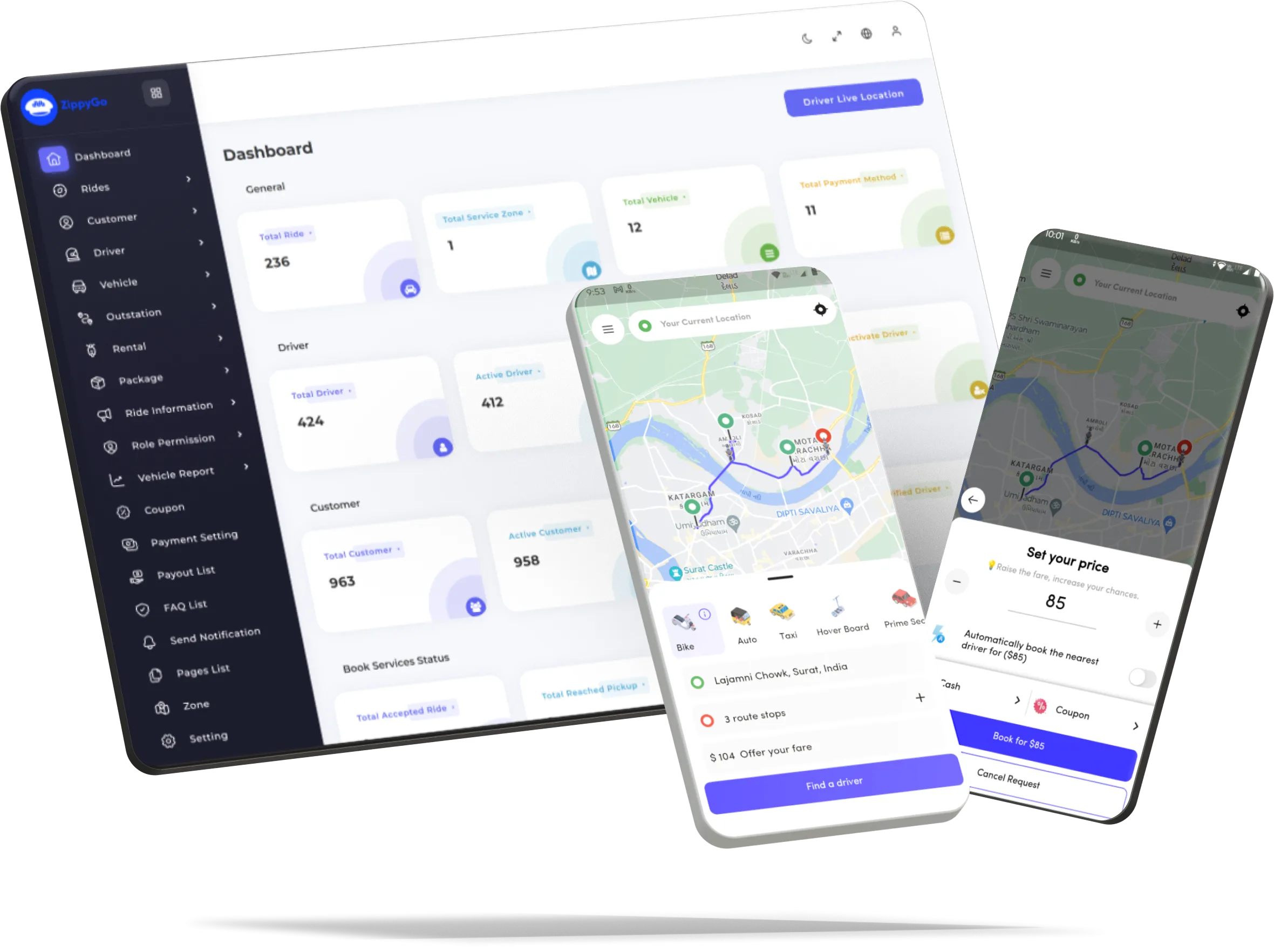
The fastest and most cost-efficient path to launching a ride-hailing platform is using a white-label taxi booking app. CSCODETECH's taxi booking solution (and ZippyGo — the inDriver-style bidding taxi app) are both Flutter-native, production-ready platforms that can be launched with your branding in 2 business days.
Features included: GPS tracking, surge pricing, multiple vehicle types, 12+ payment gateways, driver bidding system, bike taxi mode, carpooling mode, and full admin panel. Try the live demo here.
Frequently Asked Questions
How much does it cost to build an app like Uber?
A white-label Uber clone can be launched for $5,000–$15,000 in 2–5 days. Full custom development costs $30,000–$80,000 with an India-based team, or $150,000–$500,000 with a US/UK team depending on the feature set.
What is the inDriver bidding model and why is it winning?
inDriver allows passengers to set their own price. Drivers can accept, counter-offer, or decline. This model removes algorithmic pricing and resonates strongly with price-sensitive markets. inDriver is now the most downloaded ride-hailing app in 30+ countries across Africa, Latin America, and Central Asia.
Can one app support both car taxi and bike taxi?
Yes. CSCODETECH's ZippyGo supports multiple vehicle categories — bike taxi, auto-rickshaw, economy car, premium car — all within a single app with separate pricing rules per category and zone.
How long does it take to build a ride-hailing app from scratch?
Custom development takes 4–8 months with an India-based team and 8–18 months with a US/UK team. White-label launch takes 2–5 business days. For most early-stage startups, white-label is the right starting point — you can validate demand, onboard drivers, and raise funding before investing in custom development.
What is the best payment gateway for a taxi app in Africa?
PayStack and Flutterwave are the dominant options for Africa — both support Nigeria, Kenya, Ghana, South Africa, and other key markets. Flutterwave has slightly broader country coverage. For mobile money (M-Pesa, MTN Mobile Money), you will need a direct integration or a third-party aggregator like Beyonic.
Do I need to own the source code to launch?
Not necessarily. Many successful taxi app businesses launch with white-label solutions where the source code is not included. You own the brand, the customer data, and the business — and you can migrate to a custom codebase later once you have proven traction. Source code is recommended if you plan to build in-house development capability or need unique features that require deep customization.


